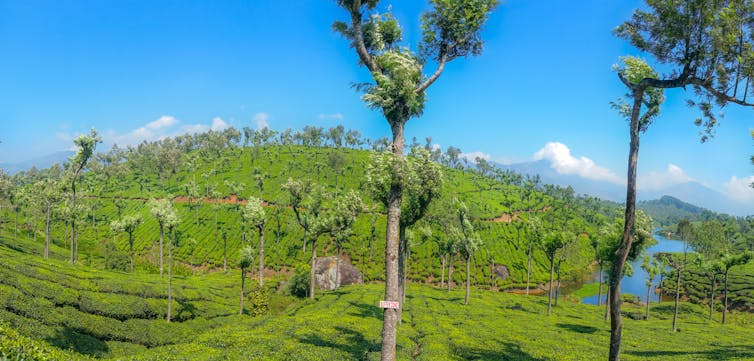
These food forests are more than just environmental safeguards; they bring profound socioeconomic benefits. They have drastically transformed agricultural practices, evidenced by the shift from cultivating just two crops annually to a diverse range of 18 crops within a mere two years in Africa's Great Green Wall region. This diversity not only bolsters nutritional intake for families but also provides a more stable economic foundation than traditional farming methods. Furthermore, these forests create a more dynamic habitat for wildlife, fostering a biodiverse and resilient ecosystem. Alongside planting 40,000 trees in Forest Gardens and contributing to ocean cleanup efforts, these food forests are pivotal in building economic resilience and supporting communities grappling with the impacts of climate change. This multifaceted approach to agriculture and environmental stewardship presents a significant leap towards a sustainable and ecologically balanced future.
The Savanna Institute is making a real effort at promoting and establishing tree farming as a viable agricultural option in the US Midwest. Check out the video below, which can serve as a high-level introduction to their work.
“Agroforestry” – the practice of having trees as part of farms – is as old as agriculture itself. But as a field of scientific enquiry and policy making, it’s now marking its 40th birthday.
In 1978 the International Council for Research in Agro-Forestry was created to document the use of trees on farms – as a source of income, food and for a healthy environment – and spread information about it. Research gradually became a stronger focus and today it is known as the World Agroforestry Centre.
It’s an important area of research because more than 40% of the worlds’ agricultural lands have at least 10% tree cover. Because the interactions between trees, soils, crops and livestock can be positive or negative, their relationship must be balanced and understood.
To mark this anniversary my colleagues and I from the World Agroforestry Centre, launched a book which takes stock of the science produced and what else needs to be done. A total of 80 authors looked at approaches to agroforestry and how it has contributed to the transformation of rural livelihoods and landscapes.
The key lesson from agroforestry is that tree cover needs to be understood and managed as part of a landscape, harmonising agricultural and forestry policies. This is important because they cover so much land and are vital for the environment and livelihoods.
Having trees on farms has huge benefits for farmers. It could mean more income, a more buffered climate, shelter from winds and rain and, because of tree roots and leaf litter, soil is protected and nurtured.
With the current global push for “climate-smart” policies, agroforestry has presented itself as a way forward.
The beginnings
The first section of the book reviews the science of trees, soils and their interactions with crops.
Agroforestry research had to first establish that, contrary to the way agriculture and forestry was presented by policymakers and in policy as separate worlds, it exists.
There’s a relationship between trees and crops that happens in many places, in many forms, involving at least 600 species of trees worldwide.
But because agriculture and forestry were treated separately in policies, there were challenges in how trees on farms should be managed. For instance, farmers with a lot of trees on their land often got caught in forestry rules in terms of how they could use them.
An example of this was that many francophone African countries inherited laws at independence which declared that all trees belonged to the state. This meant farmers started to remove them where they could, because trees compete with crops for resources like water, leading to soil degradation.
The policy only changed after farmers in Niger found ways to circumvent the rules and show that farmers could own trees and land would regenerate as a result. Other countries in the Sahel followed suit.
Policymakers eventually began to change their views when they understood how farmers, trees, forests and water interacted at the landscape scale.
Transformations
The second section of the book looks at six landscapes around the world where agroforestry actions by farmers, supported by scientists, helped local transformations to happen.
One example, where local projects inspired change elsewhere, was in Shinyanga, northern Tanzania. Drought, overgrazing and political changes had led to forest loss and land damage. A project – between government, the World Agroforestry Centre, International Union for Conservation of Nature and local partners – successfully restored 370,000 hectares of land.
Key lessons from this project were to use land practices that contributed to livelihoods (like planting trees that would bear fruits) – and linking planning to national policies.
Examples like this began to show policymakers that bridges are needed between forest-based institutions and agricultural ones. It also showed how agroforestry can contribute to current global issues of focus – like climate change and the Sustainable Development Goals. For example, growing plants with oil-rich seeds, like Jatropha curcas a flowering plant native to the American tropics, which can produce biofuel (fuel produced from living matter). Or growing certain trees in areas because they can help manage water flows.
The future
The final part of the book suggests a way forward for the communication between science and policymakers.
Scientific knowledge can help in four stages of a policy process:
Exploring new issues and sorting out which ones deserve to be on the agenda for public discussions
Identify the underlying causes that need to be addressed in policy commitments
Clarify the trade-offs that any policy implementation will face, and ways to make these manageable
Setting up ways to monitor change, so that there still is space for innovative solutions.
The book highlights that land use policies must connect local action with global concerns. It demonstrates the potential that agroforestry has for the Sustainable Development Goal agenda.
It’s now over 50 years since the world was first warned that resources were being used at an unsustainable rate. It has now been estimated that almost one quarter to one third of the world’s land is degraded to some extent.
Degradation refers to land that’s lost nutrients, or has changed physically, and therefore produces less or supports less life. This is mostly caused by the loss of soil, changes in the quality of the soil, or changes to land cover – like trees being cut down.
About 20% of agricultural land and 40% of forests are degraded. Degradation reduces our capacity to feed a world population that will reach at least 9 billion people by 2050 and it destroys ecosystem services – like the supply of clean water. Also when soil is degraded and trees destroyed, the carbon they contain is released into the atmosphere. Having high levels of carbon in the atmosphere is a major cause of climate change.
Because a great deal of land has been changed to produce food, agroforestry, the practice of deliberately introducing trees into farms, is an important way to restore degraded land. These trees, outside of forests, have tremendous commercial and ecological value.
Because of this, agroforestry is increasingly being recognised as a key practice, supporting nine out of the 17 sustainable development goals – the global action to end poverty and protect the planet.
Unfortunately policymakers have not yet caught up. Very few agricultural policies around the world promote agroforestry and few agricultural universities and training institutes include it in their syllabuses.
This needs to change if agroforestry is going to be widely adopted across all farms to meet local and global challenges of food production, environmental protection and the alleviation of climate change.
Protecting trees and soil
Trees are vital to a healthy and balanced environment as they store carbon – trees hold three quarters of the carbon found in agricultural land – which affects climate change, and protect soil. Soil supports the growth of plants, also stores carbon and is key for nearly all agricultural production.
The international community has recognised this and is in a battle to restore degraded forests. Countries have pledged to restore about 170 million hectares of land worldwide.
These are massive commitments and the question is where the efforts can be placed and land will be found.
The International Union for Conservation of Nature has identified 160 million hectares of land, in 26 countries, with restoration potential.
But most of these areas will be “mosaic” land, where trees would need to grow within managed, mainly agricultural, landscapes. The reason is very simple: most of the forest that has been lost has been transformed into agricultural land, and that land won’t be recovered as long as the demand for food continues to grow. If we need more trees, many will have to be introduced into managed agricultural mosaic landscapes.
Fortunately, trees can be valuable and profitable parts of agricultural systems. They provide timber, food and fuel. They make soils more fertile, and protect the ecosystem services that agriculture depends upon. Trees on farms bring immediate benefits to farmers and contribute 17% of gross income in tree-growing households in sub-Saharan Africa.
Slow uptake
Increasing tree cover on farms is more than an ambition, it’s already happening around the world, especially on smaller, mixed farms. Recent research shows that 45% of farms worldwide have more than 10% tree cover.
But, for its part, mainstream agriculture – still tends to ignore the need to plant trees and there are two reasons for this.
Firstly, agroforestry as a modern approach to farm production and land management – in contrast to agroforestry as a traditional farming practice – is a relatively new idea, dating back only to the 1970s. Agriculture and forest institutions around the world have been slow to adapt themselves.
Secondly, agroforestry gets lost between agriculture and forestry ministries and departments, often hosted in one institution and ignored by the other. This precludes the joining of forces of different specialists needed to push the agenda of trees on farms.
Some countries are breaking this trend. India, for example, has developed a pioneering national agroforestry policy, supported at federal level, funded down to state level and with incentives for state universities to reform their agricultural syllabuses to include agroforestry.